


18 Nov The Pan as a Cost vs. The Pan as an Investment
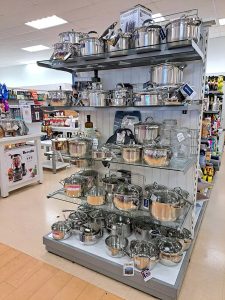 Walk down the cookware aisle of any cookware or department store today and you’re confronted with a dizzying array of choices – familiar names stamped into stainless steel, embossed across pastel ceramics, and etched into non-stick aluminum. Trace the ownership, find the “parent” companies, and you’ll find that in the last couple of decades nearly all mainstream cookware brands have been consolidated under a few conglomerates and investment firms, and that the wares themselves are distinguished mostly by indifference to what made their brands famous.
I recently read an analysis of cookware manufacturing – the state of the industry, as it were – and was stunned by the number of brands steadily absorbed by buyouts from one year to the next. The sequelae are sobering for anyone who values well-made kitchen tools: venerable cookware brands are being transformed from meaningful participants in your dinner plans into leverage for extracting returns on borrowed capital.
When large licensing conglomerates or investment groups acquire a legacy brand, priorities get “updated”. The brand name is the “must have”, bringing with the reputation that made the name. Reputation becomes an account to spend down, while manufacturing becomes an expense to be minimized. Taking on debt to hype the name (reputation) necessitates cutting supply chain costs, and design decisions shift to stressing quality “perception” and margin targets over durability and performance. Materials and specifications are quietly whittled down to sharpen the bottom line.
It’s hard to miss that in the last several decades conventional cookware manufacturing has defaulted to layered construction — cladding, coatings, and synthetic non-stick surfaces — dials that can be easily adjusted for cost while at the same time refreshing marketing spiels. The trade is out of self-explanatory robustness and into persuasive messaging, hiding low-cost inputs, more dedicated to manufacturing a replacement market than a durable good.

As anyone who has ever used them knows, so-called “ceramic” (silicates (clay) suspended in a polymer (Sol-gel) matrix) non-stick coatings lose their slickness after a minimum of normal use, leading predictably to “deceptive practice” class action lawsuits. Less known is that several premium clad pans have quietly settled such suits concerning such things as “explosive delamination” and exposed edge corrosion caused by normal dishwasher detergents. Their solution? Leave the product unchanged and remove “dishwasher safe” from the packaging inserts. Edge corrosion is an early warning of delamination – separation of metallic layers, which is effectively the death of the pan.
When production efficiency is prioritized over longevity, cookware, like so many previously heirloom goods financialized for their reputations, quickly becomes consumable (i.e., disposable) household slop.
As skilled home cooks sense these changes and seek out traditional cookware made in traditional ways, acquisitive investment firms have taken notice and begun acquiring authentic, pure-metal brands. For example, Groupe SEB—the parent company behind brands like T-fal and All-Clad—recently acquired de Buyer, the well-regarded French carbon steel maker. It will be interesting to see how this plays out – I’ve already noticed (and perhaps you have as well) de Buyer pans showing up more in influencer media. Far from highlighting a growing appreciation for classic, uncoated metal tools, this suggests to me that money sloshing around in the housewares business recognizes that the disposable model’s days are numbered. We can only hope that great French carbon steel is not about to have its All-Clad moment.
At Brooklyn Copper Cookware, we happily fly under the radar. Buying BCC means knowing what you’re buying (three pure metals, joined by hand), knowing how to buy it (selling windows), and from whom (me). We have a natural, hands-on relationship with our materials, and we like to keep a similarly natural, direct relationship with our customers. No leverage needed.
When BCC got going in 2009, finding traditional heavy copper cookware was difficult. Julia Child famously insisted upon a wall thickness of around 1/8 inch (3mm) to get the true performance benefits of copper. Because thick copper has to be turned carefully on a lathe and painstakingly hardened is tricky, by the 1980s mass-market copper makers shifted toward lighter gauges which can be shaped with industry-standard automated presses. By the turn of the century in the US, the thick stuff was easier to find used than new, and what could be found would more likely than not need servicing. This suggested the shape of a business to me, and traditional heavy copper cookware itself was ready for a few of its traditions to be… well, updated.
For example, copper and tin expand together smoothly during heating; they have similar “coefficients of expansion”. Iron, a great material for handles (gray iron has been commonly used on copper cookware since the early 19th c.), expands much as it moves energy – very slowly. In traditional metal pairings, this coefficient of expansion differential eventually fatigues rivets or cracks standard gray iron handles. Barbara Stork and I modelled handles with a basal spine and palm heel cup for rotational stability, milled our joints with uncommon precision, and used a ductile iron formulation (smelted with a pinch of carbon and silicon dioxide) that radically reforms the iron’s crystalline structure to move in sympathy with its companion copper for centuries. Such updates one cannot get from a spreadsheet.
Our slightly obsessive ethos is especially apparent in our tin linings. Nowhere is the contrast between mass and hand manufacturing more apparent than in the surfaces that meet your food. A wiped tin lining naturally crystallizes into a protective layer of about .45mm. As molten tin meets a pure copper substrate, it locks into a cohesive, continuous transit pathway for the energy you’ll put into it. An experienced tinsmith recognizes a perfect bond by feel, sight, and timing, resulting in a smooth surface that naturally improves as you use it. It is a centuries-old and subtle process that relies on a lot of heat, experience, and careful handling, and not at all on automation or amortization.
A BCC pan produces reliable results and has a simple, inviting feel as a tool – possibly because it left our hands and went straight to yours. Solid metal cookware promises uncomplicated and uncompromising benefits for generations. That’s the banner BCC is proud to carry, and a big part of our business plan is to stay firmly out of step with the macro trends in our industry. It’s a very satisfying way to make a living, if not a killing.