

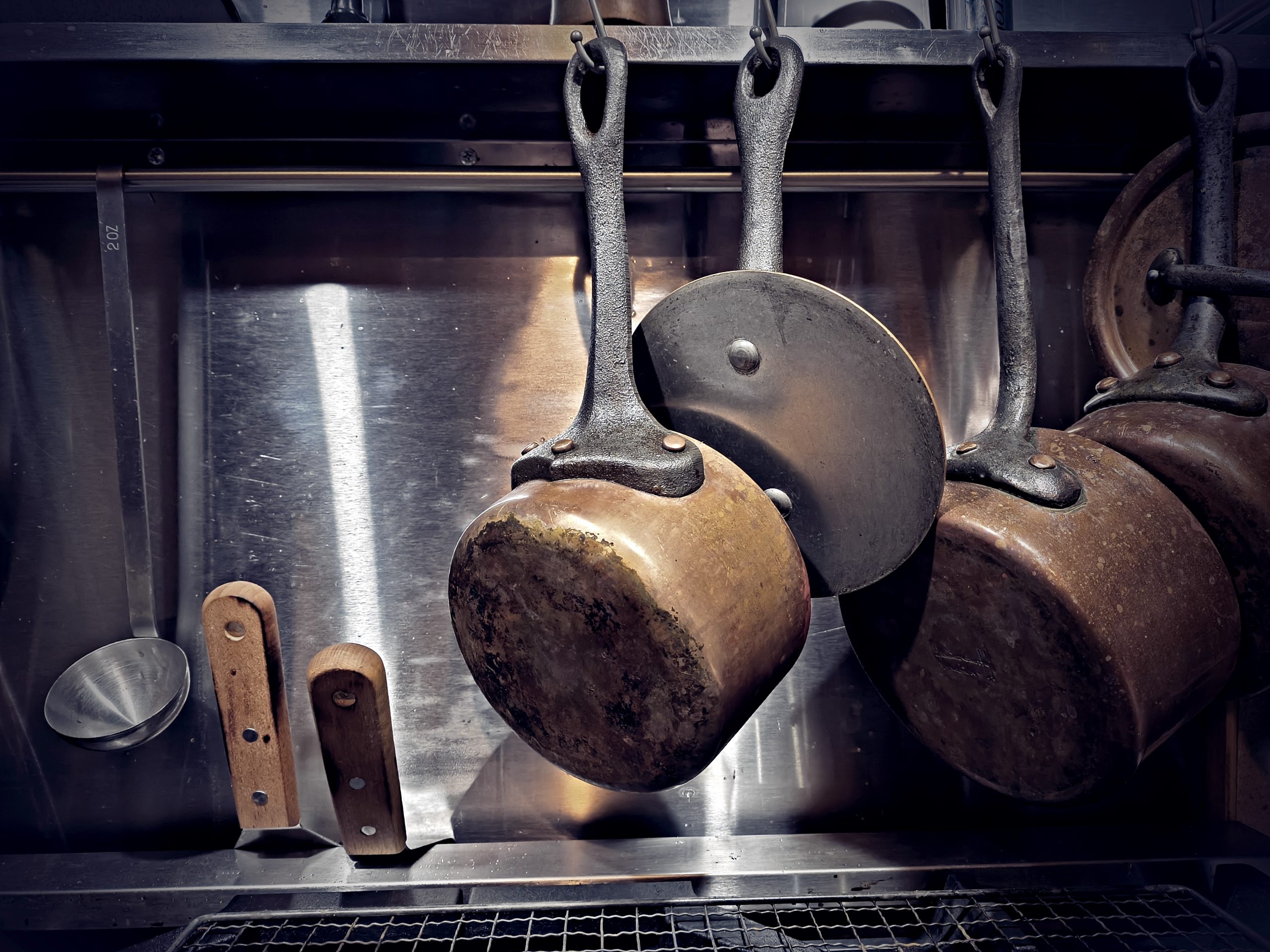
13 May What Can Sontag, Nietzsche and Lebowski Tell Us About Copper Cookware?
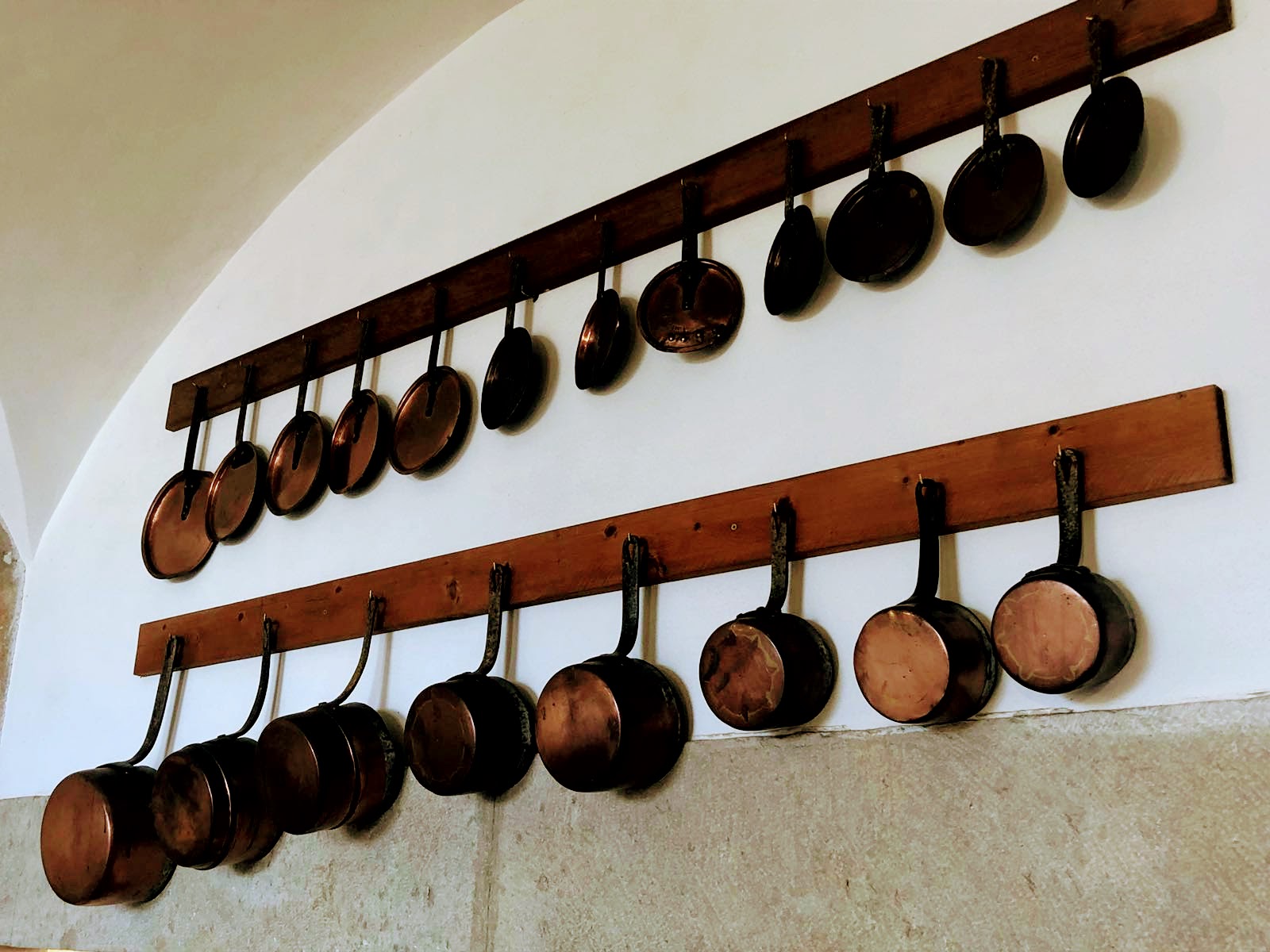
“Fewer and fewer Americans possess objects that have a patina; old furniture, grandparents’ pots and pans, the used things, warm with generations of human touch, essential to a human landscape.”
Melancholy Objects: On Photography, by Susan Sontag, Picador, 2001.
Retooling has necessitated excavating over a decade of material specifications, mechanical drawings, and back-of-the-envelope sketches that collectively fused into BCC – first in Brooklyn, then again in Ohio and Indiana, and now in Texas as BCC v. 3.0. While we upgrade lathe motors and other tools to handle heavier raw materials, I’ve had time to linger with the company’s basic ideals as I package them with BCC designs for our new smiths. The fire for making the world’s finest cooking tools, as well as how the best can be made even better, has been reignited.
I’m enjoying just thinking about our cookware again. It was these kind of musings that detoured me into starting Brooklyn Copper Cookware nearly two decades ago, and that changed everything.
We’ll see if there’s more dry tinder waiting to be sparked, but in the meantime, below are some thoughts on aging well – and colorfully.
***
Well-made-and-well-used cookware, old, dented and patinated, emits an almost atavistic call and is highly prized. Our sense for what makes a good tool appeals not only to our eyes, but to our sense of mastery and the satisfaction of our commitments — to ourselves and to those we love. If, for example, you’re committed to mastering any of the culinary arts, anything you can pull off in a cheap, disposable saucepan reaches a more satisfying, more complete expression far more reliably in a solid copper saucepan – a tool which asked your commitment when you acquired it.
New copper cookware is brightly finished. Its shiny exterior is, counterintuitively, a product of etching; the buffing process scores the metal in every direction with microscopic disturbances in the crystalline structure, which cause light to refract across the surface at a variety of frequencies. As a soft metal new copper yields to friction and gentle abrasion enthusiastically, forming extraordinarily complex micro-prisms.
When you first heat a pan you activate the metal and cause it to begin reorganizing itself, first at the surface, from a granularly complex (i.e., buffed) crystalline structure into a harder, smoother, more organized lattice as small crystals aggregate into larger cells (“grain growth”). Once the process gets going it appears visually as the patina, and is an expression, if you will, of the metal’s unique vibe.
Patina is often confused with oxidation. While these two processes can occur on the same pan surface, influence each other, and represent state changes, patination is primarily a mechanical process (operated on by force/energy) while oxidation is a chemical process (diverse molecules reacting to form new molecules). Chemical processes can have mechanical side effects, such as when a household chemical polish causes copper’s superficial crystalline structure to partially renucleate (or “whisker”, a kind of mitosis for metals) into smaller grains, which then prise up larger grains from their smoothly tessellated lattice, opening the spaces within which light can again dance more freely (prising the prisms). The coming and going of light across layers of any material we call translucence, but it is especially characteristic of crystal lattices that are disturbed at the surface.
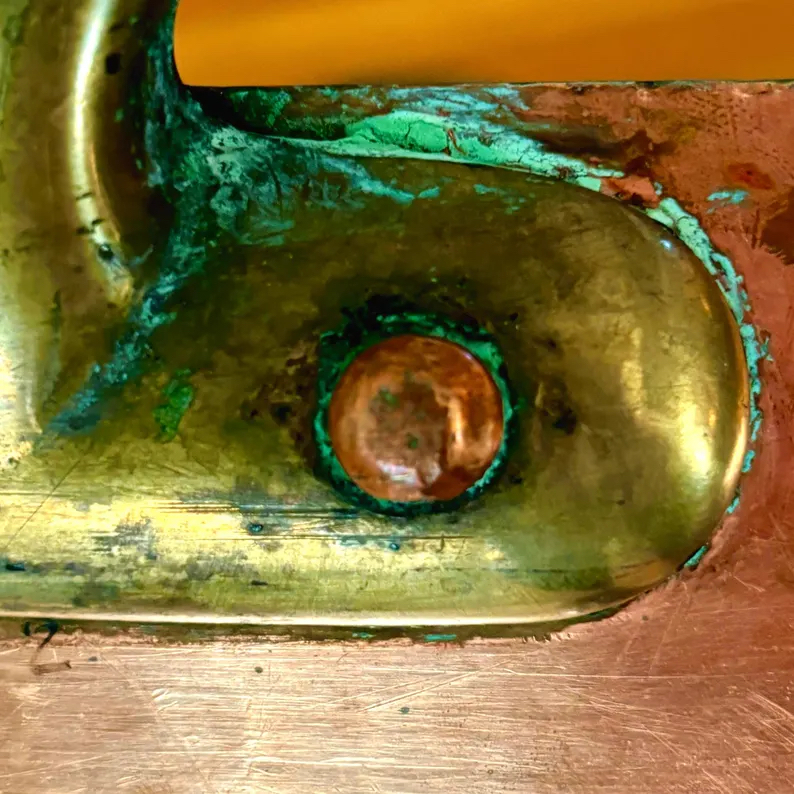
The green-gray monster
However, once the shiny dance is underway, unless the chemical agent is rinsed away whiskering continues, presenting a widening three-dimensional attack surface for ambient oxygen, which in pure copper (and high-copper alloys) catalyzes new molecules such as copper oxides, sulfates and sulfides, collectively cuprous salts, which make up the green/gray mildly toxic corrosion known as verdigris.
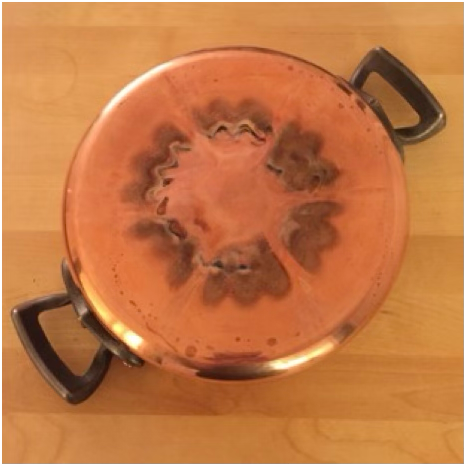
First time on heat. No pain, all gain.
The beginnings of mechanical patination is often first evident on the bottom of a new pan, where it initially encounters heat. The effect is sometimes mistaken as “scorched”, suggesting the copper has burned. It has not; rather, it’s begun a process of “conditioning”, or toughening by means of vibrationally tightening its crystalline structure as small grains aggregate. The buffed surface has begun to settle down and form larger, more interlocked crystals. As the fine etching diminishes, light refracts progressively along changing parts of the visible spectrum, resulting in the characteristic purple-blue-shifted coloration emerging from the pan base. Copperheads call this short-lived phenomenon the “bruise”.
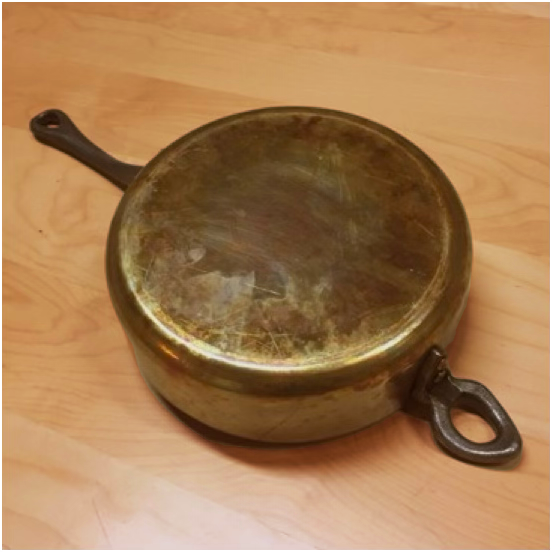
Got hot fast.
What hue of pure copper’s many bruise-moods your pan assumes will depend a lot on how much heat you put into it, and for how long. Long time on low heat will tend to bruise in the blue range of the spectrum, and is characteristic of copper crystals slowly “twinning” (aligning like opposing pages in a book). Higher heat and faster cooking will tend to shift to a yellower effect, betraying more irregularly twinned crystal structure and longer wavelengths of light escaping the surface. Generally speaking, slow (low-heat) conditioning results in tougher copper over time because precision twinning of adjacent crystals takes place at lower frequencies and needs time to vibrate into alignment.
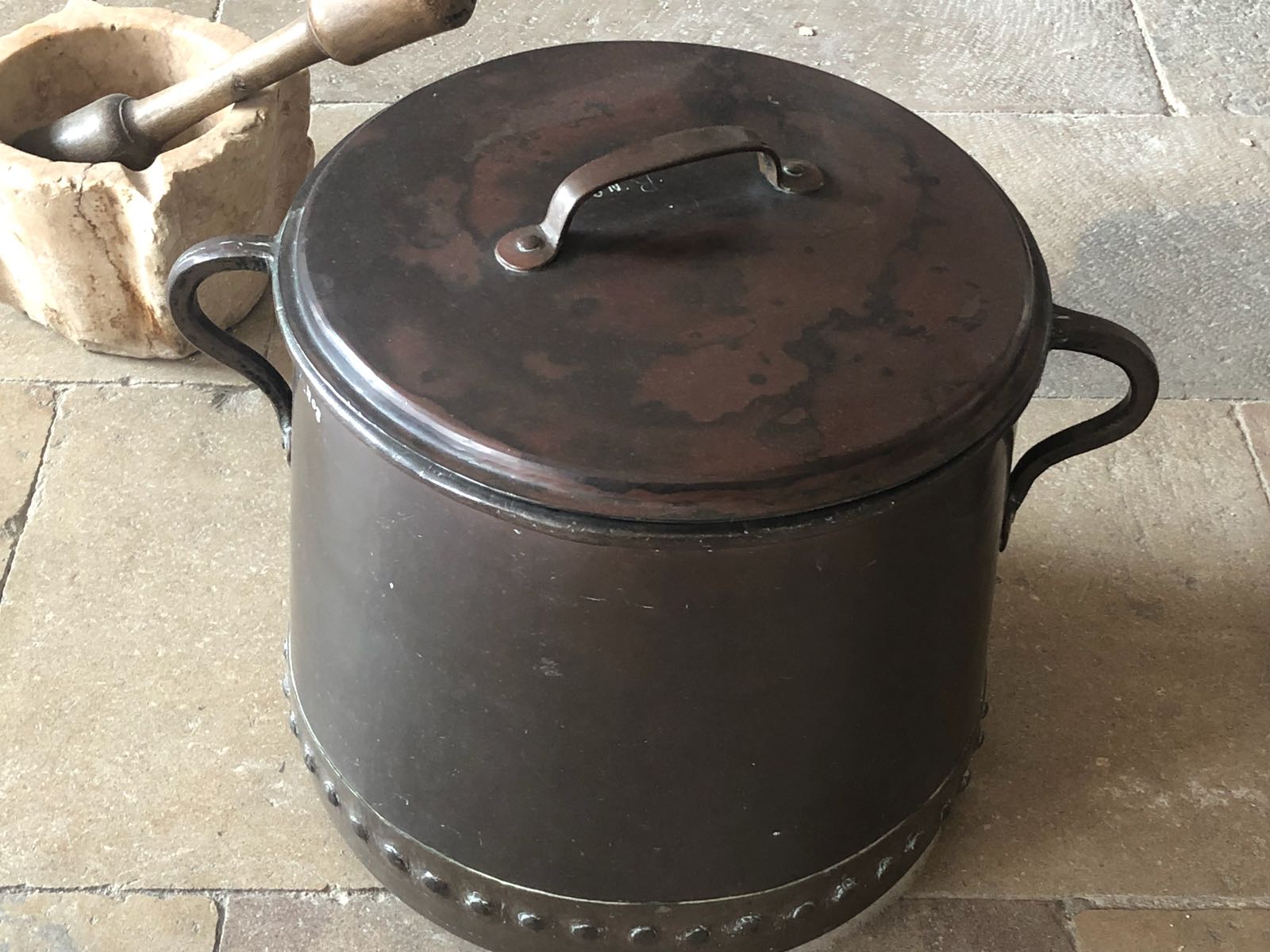
Dark age
Whether blue- or yellow-shifted, a copper bruise yields fairly quickly to more uniform patina; a kind of dusky russet hue regardless of the metal’s native red or yellow cast. For example, this 100+ year old stock pot (right) is uniformly patinated as a vessel that has been used exclusively for boiling operations would be, having conditioned slowly and steadily at 212℉ over years, with a minuscule amount of copper oxide forming incidentally and masking translucence to give a matte appearance.
Again, only with use does copper condition, becoming tougher and more efficient, progressively doing everything you count on it to do exceptionally well in the first place even better. Patina signals good things are happening.
It bears mentioning that, whatever surface effects your copper is showing, polishing will restore a copper pan to its original orange/pink cuprous hue. But each time will differ subtly from the last; patina on a copper pan is not just a superficial phenomenon, but a continuous and subtle alteration to the metal’s entire crystalline constitution. Both chemical and mechanical polishing stand crystals up at the surface, opening fine apertures and allowing light to penetrate to deeper layers (translucence), which reveals the latest condition of the pan’s conditioning (to paraphrase The Dude). Continuing to use the pan lays those surface crystals back down, while the deeper conditioning process continues unabated. Successive polishings reveal ever fresh moods within the metal, such that polished old copper evinces an alluringly vibrant character even while hanging on the rack.
One of the great pleasures of marking years using the same piece of copper cookware is the quiet and continuous revelation of the deep structure of the metal, reminding us that its every moment spent doing what it was made to do elevates its performance and longevity, and calls to mind Nietzsche’s dictum “What does not kill me makes me stronger”. This informs the “warmth” of well-used and oft-touched things to which Susan Sontag alludes, and generates a unique kind of merit for which patina is the pied avatar.